Brilliance Research & Consultant (BRCsom)
Email: info@brcsom.com
by Independent Sports Research Unit
June 13, 2026
Note Before You Read
To every person who stood with Omar Artan. To every Somali who felt pride when their flag was carried by a referee. To every African who saw themselves in his story. To every global citizen who believes sport is better than war: thank you.
Somalis appreciated the support shown around the world. Not because we sought sympathy, but because many people wanted proof that individuals can still be judged by their character, professionalism, and work rather than by their passport. The international response offered that proof.
This research is written for everyone who values fairness, dignity, and peaceful cooperation. Share it, discuss it, and use it as a starting point for constructive dialogue about the relationship between sport, politics, and human rights.
Introduction: Why This Moment Matters More Than a Trophy
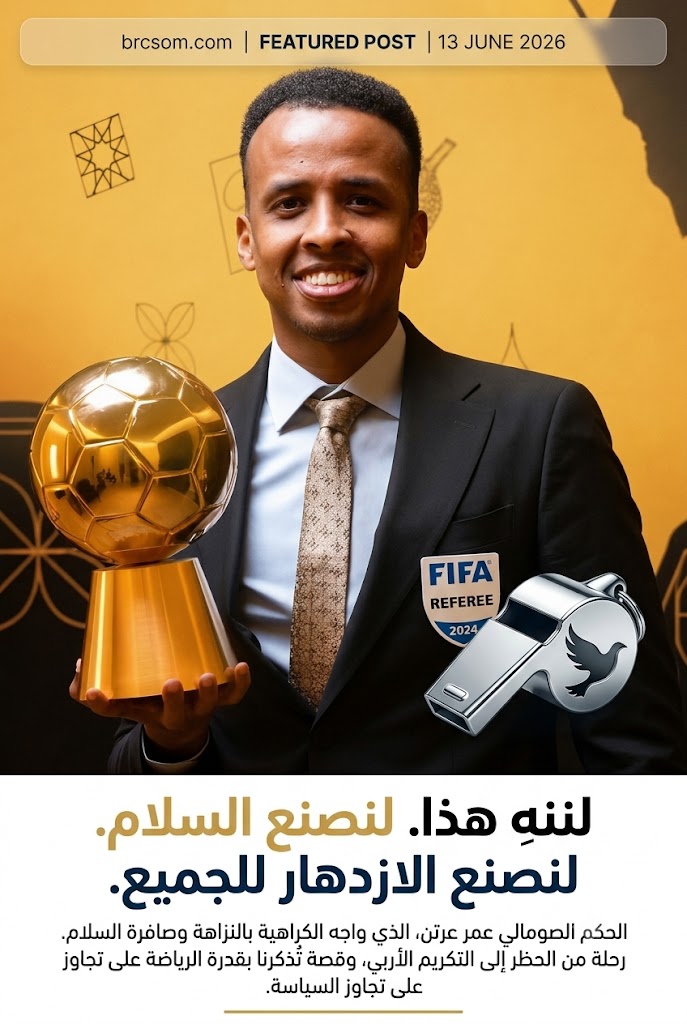
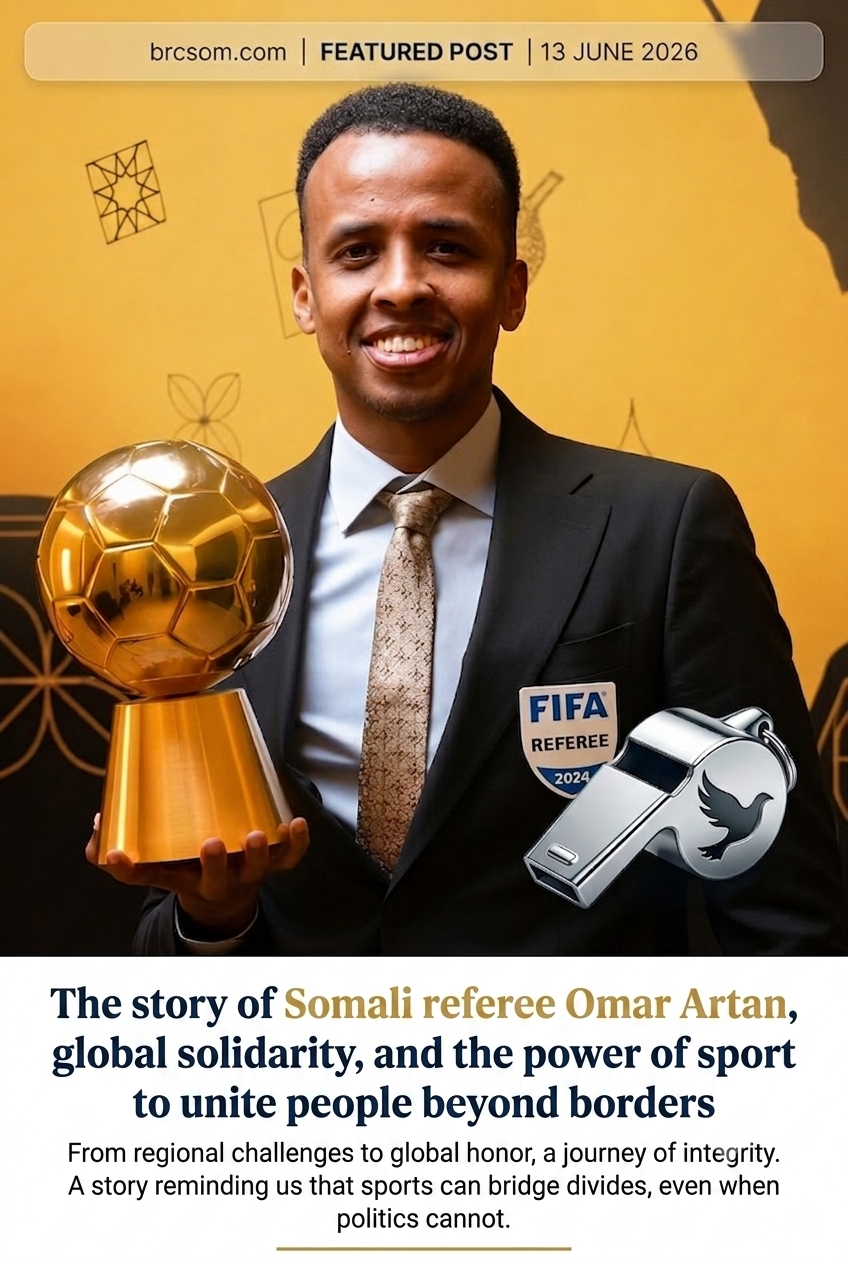
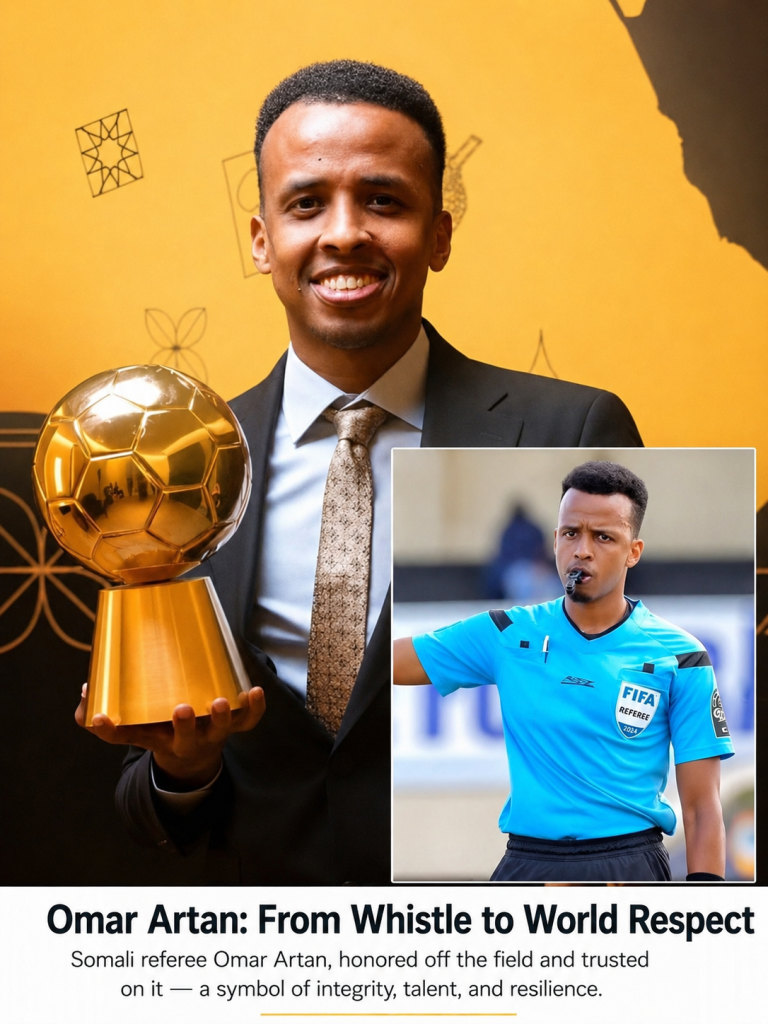
Omar Abdulkadir Cartan did not set out to become a political symbol. He trained to become a football referee, earning international recognition through years of study, physical preparation, tactical understanding, and professional discipline.
When he was denied entry to the United States under allegations of links to terrorism, the incident quickly became larger than one individual. It raised questions about evidence, due process, fairness, and the treatment of people from countries that are often viewed through a security lens.
The global reaction was significant. Public figures, sports organizations, journalists, and ordinary citizens questioned the decision and expressed concern about discrimination, collective suspicion, and the misuse of security narratives. UEFA’s decision to appoint Artan to the UEFA Super Cup was widely interpreted as a statement in favor of inclusion and non-discrimination.
This report examines that response and explores a broader question: can sport serve as a bridge between societies at a time when politics often deepens division?
Section One: The Facts of the Case
According to public reporting, Omar Artan arrived in Miami on June 7, 2026 carrying a Somali diplomatic passport and FIFA credentials related to the 2026 World Cup. U.S. authorities detained him and informed him that his visa had been revoked. Officials cited derogatory information involving alleged associations with suspected members of terrorist organizations. No public evidence was presented, and no detailed explanation was released.
Artan returned to Europe and then traveled back to Mogadishu. The case received extensive international attention. Critics argued that the decision lacked transparency and reflected broader patterns of suspicion directed at Somalis and other African nationals. Supporters of the U.S. decision maintained that governments have wide discretion in immigration and security matters.
Within days, several prominent voices publicly supported Artan. UEFA subsequently appointed him to referee the UEFA Super Cup final in Salzburg, presenting the decision as a statement for unity, equality, and non-discrimination.
Section Two: The Debate Over Security Labels
The Artan case sparked debate about how terrorism-related allegations are used in international politics. Critics argued that such labels can sometimes be applied in ways that are inconsistent, politically influenced, or lacking in transparency. They pointed to historical cases in which major powers have supported armed groups for strategic reasons and later reclassified similar actors as terrorists.
Supporters of stronger security measures responded that governments must act cautiously when national security concerns arise, even if all evidence cannot be made public. They argued that immigration authorities often make decisions based on intelligence assessments that are not fully disclosed.
The central issue is not whether terrorism exists—it clearly does—but whether accusations are applied fairly, consistently, and with adequate accountability. Many observers viewed the Artan case as a reminder that individuals should not be judged solely by their nationality or country of origin.
Section Three: Somali Unity and Public Response
Somalia has experienced political divisions, clan tensions, and regional disputes. Yet the reaction to the Artan case revealed an unusual degree of national unity. Political rivals, community leaders, athletes, and ordinary citizens publicly defended him and rejected the implication that being Somali should itself be treated as a security concern.
For many Somalis, the case resonated because it touched on a long-standing frustration: the tendency for international narratives about Somalia to focus primarily on conflict, piracy, or extremism while overlooking the country’s scholars, entrepreneurs, artists, and athletes.
The widespread support for Artan became a statement that Somalis wanted to be represented by their achievements rather than by stereotypes.
Section Four: Sport as a Tool for Peace
History provides several examples in which sport has helped reduce tensions, encourage dialogue, or symbolize reconciliation.
- Nigeria, 1967During the Biafran civil war, a temporary ceasefire was reportedly arranged around matches involving Pelé’s Santos FC, demonstrating the unusual influence of sport.
- South Africa, 1995Nelson Mandela used the Rugby World Cup as a symbol of national reconciliation after apartheid.
- Ivory Coast, 2005Didier Drogba publicly appealed for peace after World Cup qualification, contributing to momentum for dialogue.
- Iran and the United States, 1998The World Cup match between the two countries became a rare moment of symbolic diplomacy amid political hostility.
- Korea and Japan, 2002Co-hosting the World Cup showed that countries with a difficult history could cooperate on a major international event.
- Somalia and Europe, 2026UEFA’s decision to appoint Omar Artan to the Super Cup was widely interpreted as a symbolic rejection of xenophobia and exclusion.
These cases do not prove that sport can solve every conflict, but they suggest that sporting institutions can sometimes create space for dialogue, recognition, and shared humanity.
Section Five: Proposals for Reform
The report argues that international sports organizations should strengthen protections against discrimination and politically motivated exclusion. Possible reforms include:
Transparent procedures
Clear processes when athletes, referees, or officials are denied entry on security grounds.
Independent review mechanisms
Independent review mechanisms for disputed cases involving major international competitions.
Anti-discrimination standards
Strong anti-discrimination standards across FIFA, UEFA, CAF, and other governing bodies.
Sport diplomacy initiatives
Expanded programs that use sport to build cooperation between countries and communities.
The goal is not to replace national security systems but to ensure that international sport remains open, fair, and globally accessible.
Section Six: The Human Cost of Political Conflict
Modern conflicts affect people far beyond the battlefield. Wars disrupt food supplies, increase fuel prices, drive migration, and create long-term economic instability. Somalia has often experienced these effects more severely because of its geographic position and historical vulnerabilities.
Many Somalis argue that they do not want charity or exceptional treatment. They want equal treatment. The same standards that protect athletes from wealthy countries should protect athletes from poorer countries. The same respect shown to one nationality should be shown to another.
In this sense, the Artan case became a broader conversation about equality in the international system.
Section Seven: A Message to Sports Fans
Sport is often cherished because it operates under shared rules. The referee’s whistle is meant to apply equally to all players, regardless of nationality, religion, or politics.
For supporters around the world, the Artan case became a reminder that defending fairness in sport is also a way of defending fairness in society. Many fans viewed UEFA’s response as an effort to preserve the principle that professional achievement should not be overshadowed by prejudice.
Section Eight: A Message to Political Leaders
Governments have legitimate security responsibilities, but those responsibilities should be exercised with transparency, consistency, and respect for human dignity. Broad generalizations about entire nations or populations can create resentment and undermine trust.
The report encourages political leaders to avoid using fear as a political tool and to support international cooperation rather than division. It also encourages smaller nations to continue advocating for fair treatment of their citizens in global institutions.
Section Nine: Gratitude to Supporters
Many Somalis expressed appreciation to journalists, public officials, athletes, and ordinary citizens who spoke out during the controversy. The support was significant not only because it defended one referee, but because it challenged the idea that accusations alone should determine a person’s reputation.
The response demonstrated that international solidarity remains possible across national, cultural, and political boundaries.
Section Ten: Conclusion
The Omar Artan case became more than an immigration dispute. It became a debate about evidence, fairness, dignity, and the role of sport in a divided world.
The report concludes that lasting peace is built not only through security measures, but also through justice, opportunity, and mutual respect. When people are treated fairly and allowed to participate fully in global life, the appeal of violence and extremism is reduced.
Sport alone cannot solve political conflict, but it can model the principles that peaceful societies require: equal rules, recognition of merit, and respect across borders.
In that sense, the whistle carried by Omar Artan became a symbol of a larger aspiration—that people should be judged by their actions and abilities, not by their nationality.
Call to Action
This document is intended as a resource for discussion, research, and advocacy.
Organizations and individuals interested in:
- anti-xenophobia initiatives in sport
- sport-based diplomacy programs
- research on sport, politics, and human rights
- public education and advocacy campaigns
- Encouraged to collaborate and share ideas.
Contact
Website: www.brcsom.com
Email: info@brcsom.com +252 616 669 110
Final Reference Document — Free to copy, share, and distribute with attribution.