Abstract
Reports that the United States may oppose continued United Nations logistical financing for the African Union Support and Stabilization Mission in Somalia (AUSSOM) have generated understandable concern. While any abrupt reduction in international support carries risks, this moment should also be viewed as a strategic opportunity. Nearly two decades of international peace support have helped prevent state collapse and created political space for rebuilding Somali institutions. Yet the central question facing Somalia today is no longer how to sustain external missions indefinitely, but how to complete the transition toward a self-reliant national security architecture. The future of Somalia’s sovereignty depends on investing in Somali institutions rather than extending external dependence.
A Strategic Turning Point
Since the deployment of the African Union mission in 2007, Somalia has undergone significant transformation. Major urban centres have been stabilized, national institutions have gradually recovered, and the Somali National Army (SNA) has increasingly assumed frontline responsibilities. International partners—including the African Union, the United States, Türkiye, the United Nations, the European Union, and bilateral partners—have contributed to these gains through training, intelligence cooperation, logistics, humanitarian support, and counterterrorism operations.
These contributions deserve recognition. Without them, Somalia’s recovery would have been considerably more difficult.
However, successful peace support operations are not measured by how long they remain in a country. They are measured by whether they produce capable national institutions that can eventually assume full responsibility for protecting their own people. As the African Union itself has acknowledged, “the ultimate goal of any peace support operation is to create conditions for its own successful exit” (African Union, 2024, p. 15).
That should now become Somalia’s strategic benchmark.
The Lesson of Nearly Twenty Years
The international community has invested billions of dollars in Somalia’s stabilization. The United States alone has reportedly contributed nearly $2 billion to UN missions in Somalia since 2007 and over $1.6 billion to support African troops. Yet al-Shabaab continues to demonstrate operational resilience, while Somalia remains dependent on external logistical support in several critical sectors.
This reality should not be interpreted as failure alone. Rather, it highlights an important lesson repeatedly identified in international security research: lasting peace cannot be imported; it must ultimately be secured by national institutions. The World Bank (2017) has documented that countries emerging from conflict are significantly more likely to sustain peace when they possess “the institutional capacity to manage security independently” (p. 89).
The experience of countries emerging from conflict consistently demonstrates that sustainable stability depends on five interdependent pillars:
-
Professional national armed forces capable of conducting independent operations
-
Effective intelligence institutions with domestic and regional awareness
-
Capable police and justice systems that uphold the rule of law
-
Strong maritime and border security to protect national territory and resources
-
Legitimate political institutions supported by accountable governance
Where these institutions become nationally owned, security improves. Where dependency persists indefinitely, state-building remains incomplete.
Why Somalia Matters Beyond Somalia
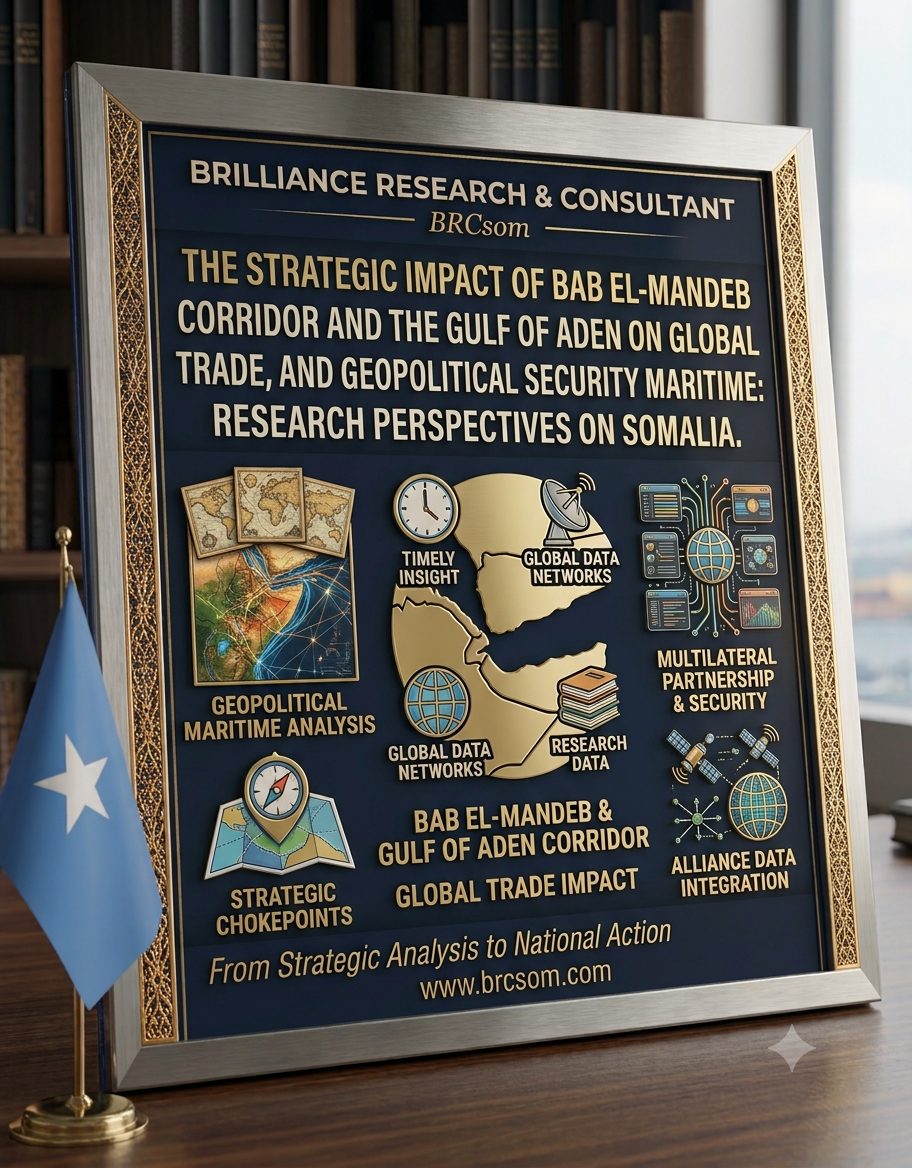
Somalia occupies one of the most strategically significant locations in the world. Its coastline links the Indian Ocean, the Gulf of Aden, and the approaches to the Bab el-Mandeb Strait, through which an estimated 10–12 percent of global seaborne trade passes annually. The United Nations Conference on Trade and Development (UNCTAD, 2023) has emphasized that disruptions in this maritime corridor affect international commerce, energy markets, humanitarian shipping, and global supply chains.
For this reason, Somalia’s security is not merely a domestic concern. It is a regional and international strategic interest. As the OECD (2020) has noted, fragile states in strategic locations “create security risks that transcend their borders, affecting neighbouring countries and global trade networks” (p. 42).
Yet this importance also reinforces an essential principle: the first line of defence for these waters should increasingly be a capable Somali state, supported by international partners—not permanently substituted by them. The United Nations Development Programme (2022) has similarly argued that “security assistance must ultimately lead to national ownership of security functions” (p. 78).
Redirecting Investment Toward Somali Capacity
If international partners reconsider the structure of future security assistance, the priority should not simply be preserving existing arrangements. Instead, resources should increasingly strengthen Somali-owned capabilities, including:
-
The Somali National Army
-
The Somali Air Force
-
The Somali Navy
-
Military logistics and maintenance systems
-
Intelligence and surveillance capabilities
-
Officer education and professional military institutions
-
Border security and maritime domain awareness
-
Domestic defence industries and technical capacity
These investments produce long-term national resilience rather than recurring operational dependence. The African Union (2024) has itself recognized that “transitioning to Somali-led security requires substantial investment in national institutions rather than indefinite mission sustainment” (p. 22).
A National Security Strategy for the Next Decade
Somalia should pursue a security strategy based on four principles:
First, maintain constructive partnerships with all countries willing to support Somalia’s sovereignty and institution-building.
Second, reduce long-term dependence by progressively transferring operational responsibilities to Somali institutions.
Third, strengthen national unity in defence planning so that federal and state security institutions operate under coherent national command.
Fourth, prioritize investments that create permanent capabilities rather than temporary external solutions.
These principles are consistent with international best practice in security sector reform and state-building, as documented by the OECD (2020) and the World Bank (2017).
Conclusion
The debate surrounding AUSSOM should not become a debate over whether Somalia appreciates international assistance. Somalia does.
Rather, it should become a discussion about what type of assistance best serves Somalia over the next twenty years.
History suggests a clear answer.
The strongest guarantee of sovereignty is not the indefinite presence of foreign peacekeepers. It is a professional Somali Army, an operational Air Force, a capable Navy, effective intelligence services, accountable institutions, and a government able to protect its citizens and territory through its own constitutional authority.
Somalia’s strategic location demands a strong Somali state. The security of the Bab el-Mandeb Strait, the Gulf of Aden, the Red Sea, and the wider Horn of Africa will ultimately depend less on how many foreign troops remain in Somalia than on how capable Somalia itself becomes.
As the old strategic principle reminds us:
“No nation can permanently outsource its sovereignty. Enduring peace is secured when a country’s own institutions become strong enough to defend it.”
The next phase of Somalia’s state-building should therefore focus on one overriding objective: building national security institutions capable of protecting Somalia by Somalis, for Somalia, while working confidently with international partners as equals rather than dependents.
Selected References (APA 7th Edition)
African Union. (2024). African Union Support and Stabilization Mission in Somalia (AUSSOM). Addis Ababa: African Union.
OECD. (2020). States of Fragility 2020. Paris: Organisation for Economic Co-operation and Development. https://doi.org/10.1787/ba5c2c0b-en
UNCTAD. (2023). Review of Maritime Transport 2023. Geneva: United Nations Conference on Trade and Development.
United Nations Development Programme. (2022). Human Development Report 2021/2022. New York: UNDP.
United Nations Security Council. (2024). Reports of the Secretary-General on Somalia and AUSSOM. New York: United Nations.
World Bank. (2017). Pathways for Peace: Inclusive Approaches to Preventing Violent Conflict. Washington, DC: World Bank. https://doi.org/10.1596/978-1-4648-1162-3
مع خالص التقدير،
الأستاذ الدكتور شافعي يوسف عمر
المدير العام للبحوث والاستشارات
Brilliance Research & Consultant (BRCsom)