Turkey, Cross-Border Terrorism, and the Case for UN Security Council Reform
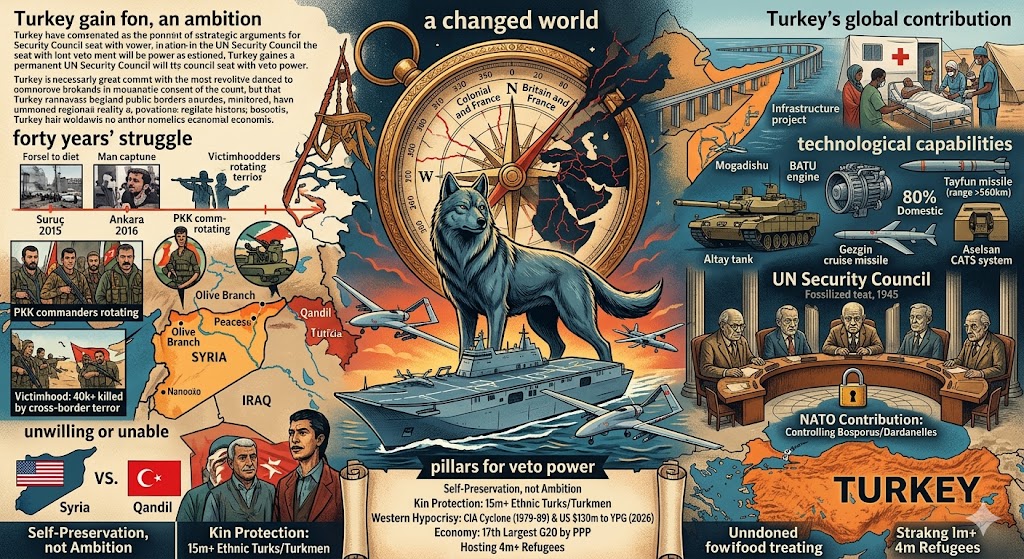
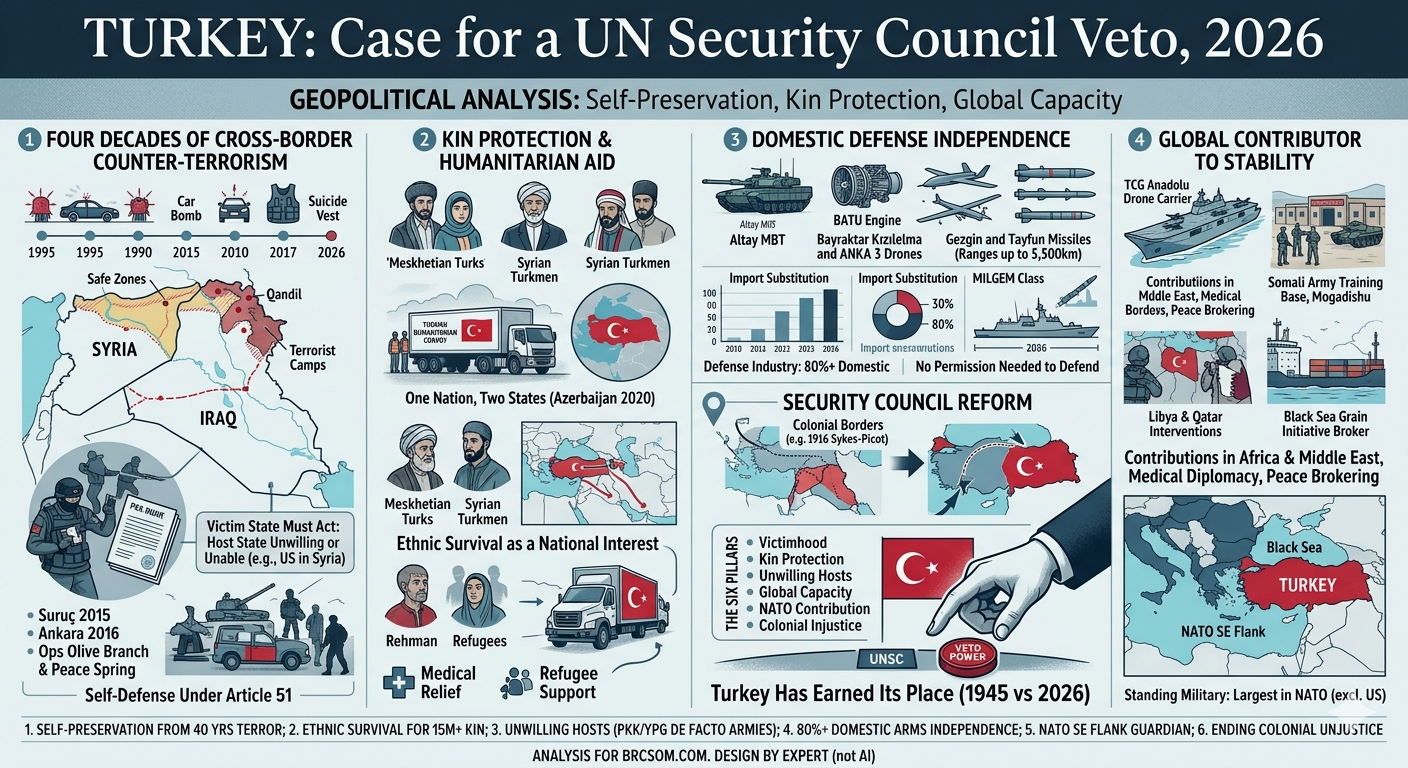
Turkey has been fighting a cross-border terrorist war for forty years while the international community watches, condemns the victim, and arms the attacker. The colonial maps drawn by France and Britain after World War One carved up ethnic populations, leaving millions of Turks and Turkmen scattered across Syria, Iraq, and the Caucasus. When those populations came under attack, the states created by those colonial powers either collapsed or proved unwilling to protect them. Turkey was left alone. The legal framework of the United Nations was designed for a world of stable, functioning states. That world no longer exists. Turkey now argues that the only way to protect its citizens, its ethnic kin, and its national security is to gain a permanent seat on the UN Security Council with veto power. This is not ambition. This is self-preservation.
The Legal Logic: Unwilling or Unable Versus Selective Sovereignty
The legal logic rests on the doctrine of unwilling or unable. Under customary international law, a state may use force on the territory of another state without that states consent if the host state is unwilling or unable to suppress a terrorist threat originating from its soil. The United States invoked this doctrine when it struck ISIS in Syria without the Assad regimes permission. The United Kingdom invoked it when it conducted drone strikes in Somalia. Turkey simply applies the same standard. Neither Syria nor Iraq can or will dismantle the PKK and YPG camps in the Qandil Mountains of northern Iraq or the cantons of northern Syria. A 2023 report from the International Crisis Group acknowledged that Iraqi federal forces have no control over the Qandil region and that the PKK operates there as a de facto autonomous military force. The same report noted that the Syrian Democratic Forces, dominated by the YPG, have refused to disband despite the territorial defeat of ISIS. When the host state cannot act, the victim state must act or accept the death of its citizens.
The Historical Precedent: When Terrorists Were Called Freedom Fighters
The historical record shows a pattern of Western hypocrisy. From 1979 to 1989, the United States Central Intelligence Agency ran Operation Cyclone, funneling billions of dollars to Afghan mujahideen fighters to bleed the Soviet Union. A senior CIA officer later described the operation as the single largest covert action in agency history. The United States provided Stinger anti aircraft missiles, logistics, and training through Pakistans Inter Services Intelligence. Public appeals were made across the Arab world for men to join the jihad. The result was the Soviet withdrawal from Afghanistan followed by the rise of Al Qaeda, the September 11 attacks, and decades of global terrorism. When a senior State Department official was asked in 1998 about the consequences of arming the mujahideen, he replied, hindsight is twenty twenty. Turkey sees the same pattern today. The United States Department of Defense allocated one hundred thirty million dollars to the YPG led Syrian Democratic Forces in the 2026 fiscal year under the Counter ISIS Train and Equip Fund. The YPG is the Syrian offshoot of the PKK, an organization that the United States, the European Union, and NATO all designate as a terrorist group. Turkey has provided thousands of pages of evidence, including captured PKK documents and operational maps, showing that commanders rotate between the Qandil Mountains, northern Syria, and southeastern Turkey. A 2021 report from the Wilson Center, a Washington based research institution, concluded that the YPG is indeed an extension of the PKK and that continued US support for the YPG is strategically incoherent. Yet the funding continues. Turkey is expected to accept this as normal.
Incidents of Turkish Victims and Western Silence
The list of incidents is long and specific. On July 20, 2015, a suicide bomber linked to ISIS crossed from Syrian territory controlled by ISIS detonated an explosive vest in the Turkish border town of Suruç, killing thirty three young activists who had gathered to help rebuild the Syrian town of Kobani. Turkey responded by opening Incirlik Air Base to the US led anti ISIS coalition. The United States praised Turkeys cooperation but refused to target the YPG, which Turkey had long identified as a terrorist organization. On February 17, 2016, a car bomb exploded in the center of Ankara, killing twenty nine people and wounding sixty one. The attack was carried out by the YPG linked Kurdistan Freedom Falcons. Turkey launched artillery and airstrikes against YPG positions in Syria. The United States State Department issued a statement calling for restraint and de escalation. No statement condemned the original attack. On January 20, 2018, Turkey launched Operation Olive Branch into the Afrin region of northwestern Syria, where the YPG had established a de facto capital. The justification was Article 51 of the UN Charter, the inherent right of self defense against armed attack. German Chancellor Angela Merkel said the operation was not legitimate under international law. The United Nations Security Council held an emergency session but took no action. On October 9, 2019, Turkey launched Operation Peace Spring to create a thirty kilometer deep safe zone along the Syrian border. The Turkish Ministry of Defense released coordinates showing that YPG fighters had used border villages to launch rocket attacks on Turkish towns, killing civilians. The European Union imposed a collective arms embargo on Turkey. France and Germany cancelled existing arms contracts, including helicopter and tank modernization programs. On December 22, 2024, the PKK attacked a Turkish military base in the Gara region of northern Iraq, killing nine Turkish soldiers and wounding several others. Turkey responded with airstrikes and ground operations under the ongoing Claw series of operations. The Pentagon issued a statement acknowledging Turkeys legitimate security concerns but urged coordination with the Iraqi government. The Iraqi government does not control the Qandil Mountains. In 2025 and into 2026, the YPG conducted raids on Arab and Turkmen villages in the Hasakah region of northeastern Syria, displacing thousands of families. Turkey demanded that the YPG dissolve and offered military training to the new Syrian government in Damascus. The United States responded by sending additional troops and drone support to YPG held bases near the oil fields. The pattern is consistent. When terrorists strike Turkey, the West calls for proportionality. When Turkey strikes back, the West calls it aggression.
The Greater Turkish Family: Protecting Kin Beyond Borders
Turkey is not only protecting its own citizens. It is also protecting its ethnic kin across the region. The Turkish government has repeatedly cited the 1994 International Law Commission draft articles on the protection of nationals abroad, which state that a state may use force to protect its nationals in another state when that state is unable or unwilling to protect them. Turkey extends this principle to ethnic kin under the doctrine of humanitarian intervention. In the 1990s, when ethnic Meskhetian Turks were attacked in the Ferghana Valley of Uzbekistan, Turkey absorbed thousands of refugees. In 2020, during the Second Karabakh War, Azerbaijan recovered its occupied territories with Turkish drone and military support. Turkish Bayraktar TB2 drones destroyed hundreds of Armenian tanks and air defense systems. Turkish military advisors worked alongside Azerbaijani commanders. No Western power condemned Azerbaiians right to self defense. Instead, France and Russia criticized Turkeys involvement. Turkish President Recep Tayyip Erdogan stated at the time, we are one nation, two states. When your brother is attacked, you do not ask for permission to help. In 2023 and 2024, as YPG forces destroyed Turkmen villages in northern Syria, the Turkish military intervened directly. A report from the Syrian Observatory for Human Rights documented that without Turkish military presence in the safe zones, Turkmen communities would have been completely ethnically cleansed from Afrin and Tel Abyad. Turkey does not seek territory. It seeks survival for its kin.
Economic Independence: Breaking Western Arms Embargoes
The economic evidence proves that Turkey no longer needs permission to act. In 2002, Turkeys defense industry was twenty percent domestic. The remaining eighty percent depended on foreign suppliers, primarily the United States, Germany, France, Italy, and the United Kingdom. When Turkey faced crises, those suppliers imposed embargoes. After the 1974 Cyprus intervention, the United States imposed an arms embargo that lasted three years. After the 2019 Peace Spring operation, the European Union imposed a collective arms embargo. France cancelled the contract for Eurocopter helicopters. Germany cancelled the modernization of Leopard tanks. Canada, a NATO ally, cancelled exports of drone optics. Turkey did not capitulate. Between 2002 and 2026, the Turkish Presidency of Defense Industries executed a deliberate strategy of import substitution. As of 2026, Turkeys defense industry is eighty percent domestic. For land systems and unmanned aerial vehicles, the figure exceeds ninety percent. Turkey produces its own Altay main battle tank. It produces its own MPT seventy six assault rifle. It produces its own ammunition, night vision systems, radios, electronic warfare suites, cruise missiles, ballistic missiles, and satellites. When Canada cancelled drone optics, Turkey switched within months to the domestic Aselsan CATS system. When German engine suppliers refused to provide engines for the Altay tank, Turkey developed the domestic BATU engine. Ismail Demir, the former head of the Presidency of Defense Industries, stated in a 2022 interview, we learned that our allies would embargo us when we needed them most. Now we produce what we need. Turkey does not ask for permission to defend itself. But it still needs a political shield at the United Nations.
What a Turkish Veto Would Have Changed
A specific case demonstrates what a Turkish veto would have changed. In October 2019, France and Germany drafted a UN Security Council resolution condemning Turkeys Operation Peace Spring. The draft resolution called for an immediate ceasefire and the withdrawal of Turkish forces from northern Syria. It did not mention the PKK rocket attacks that had killed Turkish civilians in the border towns of Akçakale and Ceylanpınar. It did not mention the YPGs forced displacement of Arab and Turkmen families. The resolution was never formally voted on because the United States and the United Kingdom signaled they would abstain, and Russia and China were prepared to veto it for their own strategic reasons. Turkey had no voice. If Turkey had held a veto, it could have blocked any resolution that failed to recognize its right of self defense under Article 51. The 2019 European Union arms embargo, which was coordinated with the UN diplomatic pressure, might never have been imposed because the political cost of isolating Turkey would have been higher. In 2024, another draft resolution circulated at the Security Council calling for unrestricted humanitarian access to northeastern Syria without mentioning that the YPG was using humanitarian convoys to move weapons and fighters. Turkey again had no say. A Turkish veto would force the Security Council to include balanced language in every resolution, acknowledging that the PKK and YPG are the same organization and that Turkey has the same right to self defense as any other member state.
Turkeys Global Contributions: Reviving Nations Without Imperial Ambition
Turkey has also proven itself as a global actor that contributes to international stability, not as an imperial power but as a modern relief mechanism. In Somalia, Turkey has built the largest overseas military base in Mogadishu, training the Somali national army. Turkish Airlines operates the only reliable commercial route into Mogadishu. Turkish cooperation agencies have drilled hundreds of water wells, rebuilt hospitals, and constructed schools. In 2011, Turkish President Erdogan became the first non African leader to walk into the Mogadishu famine zone. Since then, Turkey has treated over one hundred thousand Somali patients in Turkish hospitals at no cost. In Qatar, during the 2017 to 2021 blockade imposed by Saudi Arabia, the United Arab Emirates, Bahrain, and Egypt, Turkey was the only major power that stood with Qatar. Turkish cargo planes flew in food and medical supplies. Turkish troops were deployed to a military base in Qatar. Without Turkish support, Qatar would have been forced to capitulate. Turkish Foreign Minister Mevlüt Çavuşoğlu stated at the time, we do not choose sides. We choose what is right. In Ethiopia, when the Tigray war threatened to break up Africa second most populous nation, Turkey sold Bayraktar TB2 drones to the Ethiopian government. These drones turned the tide against the Tigray Peoples Liberation Front. Turkish medical teams operated in Addis Ababa throughout the conflict. Turkish aid agencies fed internally displaced persons in the Afar and Amhara regions. Turkey did not demand bases or mineral rights. In Sudan, before the 2023 civil war, Turkey was restoring the Ottoman era port of Suakin on the Red Sea as a civilian hub for humanitarian aid to Yemen and the Horn of Africa. When the war broke out, Turkey continued operating field hospitals in Port Sudan, treating wounded civilians from both sides. In Libya, in 2019 and 2020, Turkey intervened militarily to break the siege of Tripoli by General Khalifa Haftar, who was backed by Russia, Egypt, the United Arab Emirates, and France. Turkish drones and advisors saved the UN recognized Government of National Accord from collapse. The ceasefire that followed would have been impossible without Turkish intervention. In the Black Sea, in 2022 and 2023, Turkey brokered the Black Sea Grain Initiative between Russia and Ukraine, which exported thirty three million tons of grain and prevented famine in the Horn of Africa and the Middle East. UN Secretary General António Guterres said of the deal, Turkey has done the impossible. It has brought two warring parties to the same table and produced results that the rest of the world could not achieve.
Turkeys Emerging Global Power: Missiles, Drones, Medicine, and Neutral Diplomacy
Turkeys military and technological capabilities now exceed those of some permanent Security Council members. Turkey has tested the Tayfun short range ballistic missile with a range exceeding five hundred sixty kilometers. The Cenk missile system is reported to exceed fifteen hundred kilometers. The Gezgin cruise missile project aims for a range exceeding one thousand kilometers, and Turkish defense officials have openly discussed a national ballistic missile program targeting five thousand five hundred kilometers. Turkey operates the Bayraktar TB2, Akıncı, Kızılelma, and ANKA three drone systems, placing it among the top three drone nations globally. Turkeys naval fleet includes the TCG Anadolu, the worlds first drone carrier, and the MILGEM class frigates. Turkish naval bases extend into Libya and Somalia. In medical science, Turkey developed its own COVID nineteen vaccine, Turkovac, and is now a leader in stem cell therapies and cancer immunotherapies. Turkish hospitals serve over one million medical tourists annually. Turkish pharmaceutical companies export to eighty five countries. Turkey is a G20 member with the seventeenth largest economy in the world by purchasing power parity. Turkey has the largest standing military in NATO after the United States. Turkey hosts over four million Syrian refugees, more than any other country. Compare this to the United Kingdom, which no longer has independent missile production and relies on United States Trident missiles. Compare this to France, which has no drone fleet comparable to Turkeys. Turkey has earned its place.
The Justification for Turkish Veto Power
The justification for Turkish veto power rests on six pillars. First, victimhood. Over forty thousand Turkish citizens have been killed by cross border terrorism from Syria and Iraq. No other NATO member has suffered this directly from non state actors. Second, kin protection. Over fifteen million ethnic Turks and Turkmen live outside Turkeys borders. The United Nations does not protect them. Turkey must. Third, unwilling hosts. Neither Syria nor Iraq can or will dismantle the PKK and YPG. Turkey must act unilaterally. A veto prevents Turkey from being penalized for doing what the system refuses to do. Fourth, global capacity. Turkey fields missile programs, drone armies, naval bases, and medical infrastructure that exceed those of some permanent members. Fifth, NATO contribution. Turkey controls the Bosporus and Dardanelles, the only exit for Black Sea NATO navies. Without Turkey, NATO cannot defend southeastern Europe. Sixth, colonial injustice. The current Security Council structure reflects 1945, not 2026. Turkey was not an independent state when the veto was assigned to France and the United Kingdom. Adding Turkey is the minimum correction.
Conclusion
The world has changed. Colonial borders have failed. Terrorist groups have become de facto armies. The United Nations Security Council remains frozen in a postwar arrangement that no longer reflects reality. Turkey has done the work. It has built its own weapons. It has saved failed states. It has brokered peace between Russia and Ukraine. It has hosted more refugees than the entire European Union combined. It has asked for nothing except the right to protect its own people. The wolf does not ask the sheep for permission to guard the flock. But the world would be safer if the wolf had a seat at the table. Turkey has earned that seat.
Professor Shafai Yusuf Omar
Director General of Research and Consultation
Brilliance Research & Consultant (BRCsom)
www.brcsom.com info@brcsom.com
whatapp: +252 616 669 110