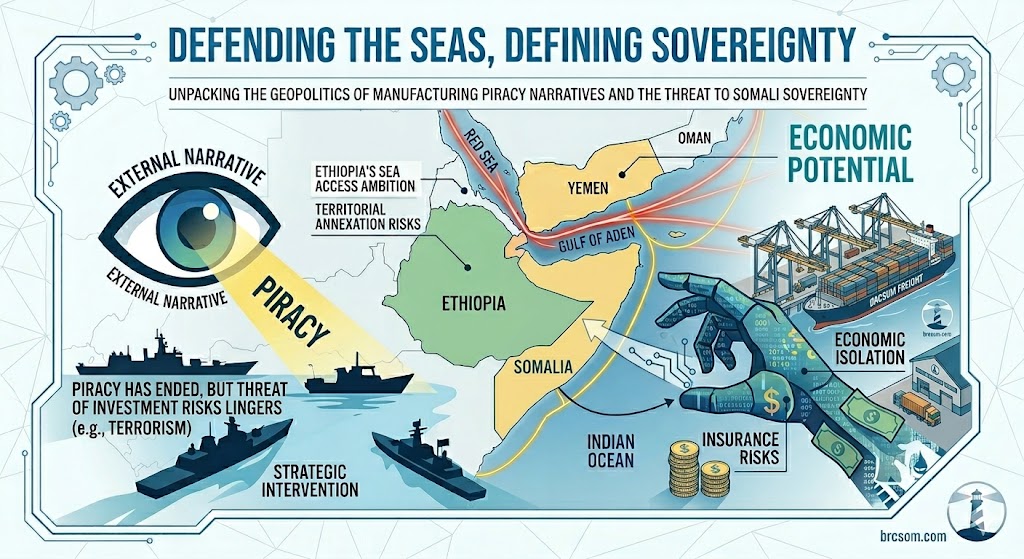
The Geopolitics of Manufacturing Piracy: How Strategic Narratives Undermine Somali Sovereignty.
Abstract
This research examines the convergence of strategic interests reshaping Somalia’s maritime domain as the global order undergoes a seismic power shift. While Western institutions report a “resurgence” of Somali piracy, this paper argues such narratives serve geopolitical objectives that fundamentally threaten Somali sovereignty. Through analysis of recent maritime incidents, diplomatic recognition patterns, and shifting interpretations of international law, the research identifies a coordinated framework wherein piracy allegations function as justification for external intervention. The timing coincides with Ethiopia’s aggressive pursuit of sea access, Israel’s strategic expansion into the Horn of Africa via Somaliland recognition, and a broader realignment where weak states become theaters for great power competition. For Somalia, the danger is existential: accepting external narratives of piracy legitimizes foreign naval presence, creates precedents for territorial annexation, and paves the path toward the very fragmentation already unfolding.
1. Introduction: The Weaponization of Maritime Insecurity
The Indian Ocean off the Somali coast has become one of the most geopolitically contested spaces on earth. For over a decade, the world was told Somali pirates threatened global shipping—until, suddenly, they didn’t. Then, just as conveniently, they returned.
But for those watching closely—those who understand that in geopolitics, facts are manufactured as readily as weapons—a different picture emerges. The “resurgence” of Somali piracy isn’t a failure of Somali governance. It’s a feature of a larger design.
The Horn of Africa sits at the crossroads of the world’s most critical maritime chokepoints. The Bab el-Mandeb Strait, the Suez Canal, the Gulf of Aden—these aren’t just shipping lanes. They’re the jugular of global trade. Between 12% and 15% of global maritime trade transits this corridor annually. Approximately 4.5 million barrels of oil pass through daily . The submarine cables carrying 95% of international internet traffic—including every global financial transaction—run along these same seabeds .
Whoever controls narrative control over these waters controls access. And whoever controls access controls the global economy.
This paper argues that the current framing of “Somali piracy”—amplified by Western maritime security institutions, legitimized by UN Security Council resolutions, and weaponized by political rhetoric—is not a neutral assessment of maritime crime. It is a strategic narrative designed to justify external intervention in Somali waters, create legal cover for military operations, and ultimately fragment Somali sovereignty to serve the maritime ambitions of regional powers and their international patrons.
2. The Shifting Global Order: Why Somalia Matters Now
2.1 The Multipolar Vacuum
The post-Cold War unipolar moment is over. The United States’ ability to impose its will unilaterally has eroded. China’s Belt and Road Initiative has created alternative trade architectures. Russia has reasserted itself in Africa through Wagner Group successors. Regional powers—Turkey, the UAE, Iran, Ethiopia—no longer wait for Western permission.
In this vacuum, weak states suffer most. Somalia, still recovering from three decades of civil war, with a nominal central government unable to control its coastline, becomes what strategists call a “permissive environment”—a space where stronger actors can operate with impunity, framing their interventions as humanitarian or security-driven while pursuing their own strategic objectives.
2.2 The Chokepoint Economy
The Suez Canal crisis of 2021, when the Ever Given blocked passage for six days, demonstrated the fragility of global supply chains. The Houthi campaign in the Red Sea from late 2023 through 2025 showed how non-state actors could disrupt global trade, forcing shipping giants like Maersk to reroute around Africa’s Cape of Good Hope at immense cost.
Somalia’s 3,333-kilometer coastline faces directly onto these chokepoints. Control over Somali waters—or at least the ability to patrol them, claim they’re insecure, and deploy naval forces there—is strategic leverage of the highest order . The country that controls the narrative of insecurity controls the right to intervene.
3. The Piracy Narrative: Manufacturing Consent for Intervention
3.1 The Numbers That Don’t Add Up
According to the International Maritime Bureau, reported piracy incidents off Somalia peaked in 2011 with 237 attacks. By 2024, that number had fallen to single digits . The European Union’s Operation ATALANTA, the primary counter-piracy mission, has repeatedly declared Somali waters safe.
Yet suddenly, in 2025 and early 2026, headlines scream of a “resurgence.” In January 2025, the Maltese-flagged tanker Hellas Aphrodite was reportedly seized 560 nautical miles southeast of Eyl—a remarkable distance for skiffs operating from Somalia’s coast . In April 2026, the oil tanker Honour 25 was allegedly hijacked 30 nautical miles from Mogadishu .
The geographical inconsistency is telling. How do pirates simultaneously operate 560 miles offshore and within 30 miles of the capital? Are these the same pirates? The same networks? Or are we witnessing different phenomena being collapsed into a single narrative of “Somali piracy”?
3.2 Whose Pirates? Whose Evidence?
The European Union Naval Force, which oversees counter-piracy operations, has released no statement confirming the Honour 25 hijacking . Neither have Somali authorities. The primary sources are “security officials from Puntland”—a semi-autonomous region with its own political agenda regarding federal relations .
In an environment where verification is impossible for external observers, allegations become reality. A ship is reported seized. Insurance rates rise. Navies deploy. And only later—if ever—does the truth emerge.
This pattern isn’t new. The 2008-2012 piracy epidemic coincided perfectly with the expansion of international naval presence in the Indian Ocean—presence that gave the United States, China, India, Japan, and the EU strategic positioning they otherwise would have struggled to justify.
3.3 The Trump Factor: Normalizing Lethal Force
President Donald Trump’s January 2026 statement authorizing Defense Secretary Pete Hegseth to “strike Somali pirate boats” with lethal force represents a dangerous escalation . Trump openly stated pirates would receive “the same missile that we give to the people that are bringing drugs”—referring to strikes that had killed over 120 people in the Caribbean .
The legal framework cited is UN Security Council resolutions dating to 2008. But Trump’s interpretation stretches these resolutions beyond recognition. Counter-piracy operations originally authorized interdiction and detention, not targeted killings. Trump’s formulation—”if anybody even makes a move toward a ship, they get the ultimate treatment”—effectively creates a shoot-on-sight policy .
More troubling is Trump’s simultaneous rhetoric about Somalia itself. He described Somali immigrants as “garbage” and questioned whether Somalia is “even a country” . This combination—dehumanizing rhetoric targeting Somalis alongside authorization of lethal force in Somali waters—creates precisely the conditions for extrajudicial killings without oversight.
The national emergency declaration regarding Somalia, renewed in April 2025, cites “acts of piracy and armed robbery at sea off the coast of Somalia” as justification for continuing extraordinary measures . This emergency has now been active for fifteen years—longer than many actual wars.
4. The Regional Land Grab: Ethiopia’s Sea Access Ambition
4.1 From Economic Necessity to Annexation
Ethiopia’s quest for sea access is legitimate on its face. As the world’s most populous landlocked country—over 120 million people—Ethiopia pays crippling port fees to Djibouti, handling over 95% of its maritime trade . This dependency is an economic strangulation.
But legitimate need has transformed into expansionist demand. The shift occurred around 2018, when Ethiopian policy moved “from a commoditized and transactional view of port access to a securitized and existential framing of sea access” . Maritime access is now framed not as economics but as “national survival.”
Prime Minister Abiy Ahmed’s language has hardened. In June 2025, he declared sea access “a matter of national survival” and vowed Ethiopia would secure it “legally and peacefully” . But peaceful legal processes aren’t producing results. And Ethiopia’s January 2024 memorandum of understanding with Somaliland—which would grant Ethiopia naval base access in exchange for potential recognition—represents the opening gambit in what may become forcible annexation.
4.2 The UNCLOS Loophole
The United Nations Convention on the Law of the Sea (UNCLOS) Articles 125-127 guarantee landlocked states “right of access to and from the sea” and “freedom of transit” . But these provisions envision cooperative arrangements with coastal states—not unilateral seizures of territory.
Ethiopian scholars now argue for more than transit rights. They cite “colonial-era disruptions” that “fragmented Ethiopia’s Red Sea linkages” and call for “shared administration or sovereign easements” . Some suggest Ethiopia’s historical control of ports like Assab before 1991 creates “effectivités”—legal facts on the ground that persist despite Eritrean sovereignty .
This is dangerous logic. Applied universally, it would unravel the post-colonial state system across Africa. But in the Horn’s current power dynamics—with Somalia weak, Eritrea isolated, and Ethiopia ascendant—might may make “right.”
4.3 Why Not Djibouti? Why Eritrea? Why Somalia?
If Ethiopia only needs port access, Djibouti already provides it. The Ethiopia-Djibouti railway and road corridor handle vast trade volumes. Economically, this arrangement works.
So why the push for Somaliland’s coast? Why the rhetoric about Eritrean ports?
Because this isn’t about commerce. It’s about sovereignty over territory and water. Ethiopia wants its own port—not transit through another country’s—because control matters more than efficiency. A leased port in Somaliland or seized port in Eritrea would give Ethiopia direct Indian Ocean access, naval basing rights, and the ability to project power regionally .
For Somalia, this is catastrophic. Somaliland’s breakaway status already fragments Somali territory. If Ethiopia secures a base there—with potential recognition of Somaliland as sovereign in exchange—Somalia loses not just land but the legal principle of its territorial integrity.
5. The Israel Connection: Somaliland Recognition as Strategic Expansion
5.1 Recognition as Weapon
On paper, Israel’s recognition of Somaliland in 2025 seemed inexplicable. Somaliland is not recognized by any other UN member state. The African Union explicitly opposes recognizing breakaway entities.
But Israel doesn’t operate on paper. It operates on strategic necessity.
The Houthi threat across the Bab el-Mandeb—less than 30 kilometers from the Horn of Africa coast—has transformed Red Sea security. Houthi missile and drone strikes on Israeli-linked shipping throughout 2024-2025 demonstrated Iran’s ability to pressure Israel via maritime chokepoints.
A military base in Somaliland—on the African side of the Bab el-Mandeb—would give1 Israel the ability to monitor, disrupt, or retaliate against Houthi activity from close range. Reports suggest Israel views Somaliland as “a strategic counterweight against Houthi forces across the Gulf of Aden” .
5.2 Somalia’s Rejection and the Cost
Somalia’s President Hassan Sheikh Mohamud has rejected Israeli presence categorically, declaring Somalia “will never allow an Israeli military base” and vowing to “confront any Israeli forces entering Somaliland” . He called recognition of Somaliland “a reckless and illegal move that threatens Somalia’s sovereignty.”
But rejection without enforcement capability is theater. Somalia’s navy is virtually nonexistent. Its army struggles against al-Shabaab. It cannot prevent Israel from establishing presence in a territory it doesn’t control.
The broader pattern is unmistakable. Israel’s expansion arc—from Iraq (via operations against Iranian proxies) through Syria (via Golan Heights and buffer zones) to Egypt (via Gaza border and Sinai coordination)—now reaches the Horn of Africa. Somaliland becomes a node in a network of Israeli outposts surrounding the Arabian Peninsula.
For Somalia, this means another actor with no respect for its sovereignty establishing permanent presence on its claimed territory.
6. Institutional Complicity: Western Maritime Security Complex
6.1 UK Maritime Trade Operations (UKMTO)
The United Kingdom Maritime Trade Operations, housed in Dubai, serves as the primary reporting point for maritime incidents in the Gulf and Indian Ocean. Its reports are taken as authoritative by insurers, shipping companies, and navies.
But UKMTO’s funding comes from the UK Ministry of Defence. Its personnel are Royal Navy officers. Its “neutral” reporting serves British strategic interests—including maintaining justification for naval presence in the region.
When UKMTO reports a “suspicious approach” or “attempted boarding” off Somalia, that report shapes policy. No independent verification is required. No Somali authorities are consulted. The narrative flows one way: from Western naval sources to Western media to Western policymakers.
6.2 The Insurance-Reinforcement Loop
Maritime insurance operates on risk assessment. When Lloyd’s of London designates an area “war risk” or “piracy risk,” premiums rise. Shipping companies either pay more or reroute. Both outcomes serve geopolitical interests.
Higher premiums hurt Somali trade—discouraging ships from calling at Mogadishu or Kismayo ports, economically isolating Somalia further. Rerouting reinforces narratives of Somali waters as dangerous.
But who designates “piracy risk”? The same Western institutions that rely on Western naval reporting. The loop reinforces itself: allegation → report → insurance designation → economic harm → justification for intervention.
7. The Strategic Logic: Why Piracy Narrative Benefits Interventionists
7.1 Legal Cover for Naval Presence
UN Security Council resolutions authorize counter-piracy operations off Somalia. Without piracy, this authorization lapses. Navies would need bilateral agreements with Somalia—agreements Somalia could refuse.
The piracy narrative thus provides multilateral legal cover that unilateral basing agreements cannot. Operation ATALANTA, NATO’s Operation Ocean Shield, and various national deployments all derive legitimacy from the piracy threat.
If that threat is manufactured—or at least exaggerated—then this naval presence constitutes a form of occupation without consent.
7.2 Precedent for Intervention
The Responsibility to Protect (R2P) doctrine, invoked for Libya in 2011, remains controversial. But a lower threshold—”maritime security”—has gained acceptance. If Somali waters threaten global shipping, intervention