Africa’s Democratic Awakening: Lessons from the American Model
By Professor Shafici Yusuf Omar
Introduction: A Turning Point for Africa
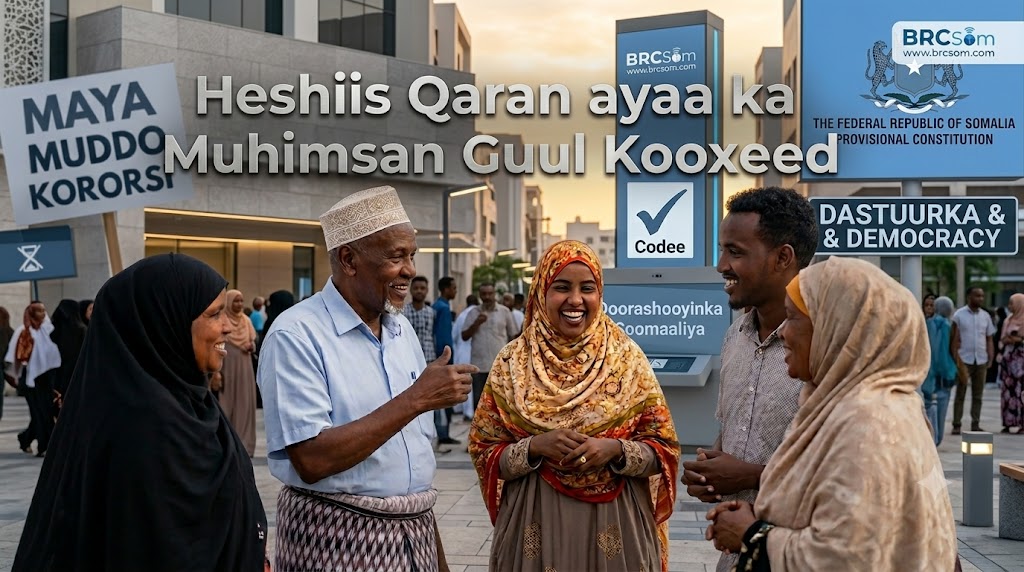
Across continents, democracy is being tested — yet renewed. The election of Zohran Mamdani as New York City’s first Muslim mayor and the leadership of Omar Fateh in Minnesota reveal something profound: the United States, despite its divisions, remains a living laboratory of opportunity.
For Africa, especially Somalia, this is not a distant story. It is a mirror — reflecting what becomes possible when law, institutions, and people’s voices prevail over fear, corruption, and inherited power.
1. The USA: A Model of a Self-Correcting Democracy
The American system is not perfect, but it has one strength: it repairs itself.
From the Civil Rights Movement to the election of Barack Obama, from protests against injustice to fair transitions of power — the lesson is clear. The strength of a nation lies not in avoiding mistakes but in building systems that correct them.
Even when leadership shows arrogance — as seen in Donald Trump’s public rudeness or political threats — the American institutions held. Courts, voters, and civil society all stood firm. That is democracy in action: the system, not the leader, defines the nation.
2. Somalia and Africa: Between Potential and Paralysis
Africa’s greatest challenge has never been a lack of resources, but a lack of rule of law and institutional trust.
From Somalia to Sudan, from Congo to Niger — every crisis that collapsed a state was rooted in one simple truth: leaders became stronger than the constitution.
When laws are negotiable, elections lose meaning; when justice is for sale, development dies.
Somalia’s transition governments show promise, but without constitutional completion, independent judiciary, and strong anti-corruption frameworks, democracy remains fragile.
3. What the USA Teaches: Institutions Above Individuals
America’s founding principle — checks and balances — ensures no one becomes a king.
Even the president is limited by courts, media, and people. This is what Africa must learn: build systems, not saviors.
When Somali mayors or ministers are elected for merit, not clan, progress follows.
The success of Omar Fateh and Zohran Mamdani — both of Somali and South Asian heritage — shows that merit-based leadership is achievable when opportunity replaces identity politics.
4. Proof from the Past: Where the Rule of Law Worked
- Botswana stands as one of Africa’s cleanest democracies — built on institutions, not slogans.
- Ghana continues peaceful transfers of power through independent electoral commissions.
- Rwanda, despite its centralized governance, proves that stability and public trust can coexist with reform.
In contrast, Libya, Sudan, and Somalia’s early years prove that ignoring law and order invites endless resets.
5. The Path Forward for Somalia and Africa
To rise, Somalia and Africa must:
- Finalise constitutional reforms ensuring federal balance and justice.
- Establish independent electoral bodies free from political influence.
- Enforce anti-corruption courts to restore trust.
- Expand education on civic duty — so every child learns democracy as a shared value.
- Empower the diaspora to invest, lead, and innovate at home.
Democracy is not a Western gift — it is a universal human discipline.
6. A Message to the World: Gratitude and Hope
As we congratulate America, New York, and Minnesota for keeping the democratic spirit alive, Africa says: thank you for the lesson.
Your example proves that no voice is too small, no origin too humble, and no faith too foreign to lead in a free society.
Let this moment inspire African nations to reform not by imitation, but by conviction — to make democracy our own African pride, rooted in justice, equality, and truth.
Conclusion: From Inspiration to Action
Somalia’s future will not be shaped by external aid or foreign advice, but by its people’s choice to believe — as America once did — that institutions must serve the people, and leaders must serve the law.
The rise of Zohran Mamdani and Omar Fateh is not an American story alone.
It is a Somali story, an African story, and a human story of renewal.
With sincere respect,
Professor Shafici Yusuf Omar
Director General of Research & Consultancy
Brilliance Research & Consultant (BRCsom)
www.brcsom.com info@brcsom.com
+252 616 669 110