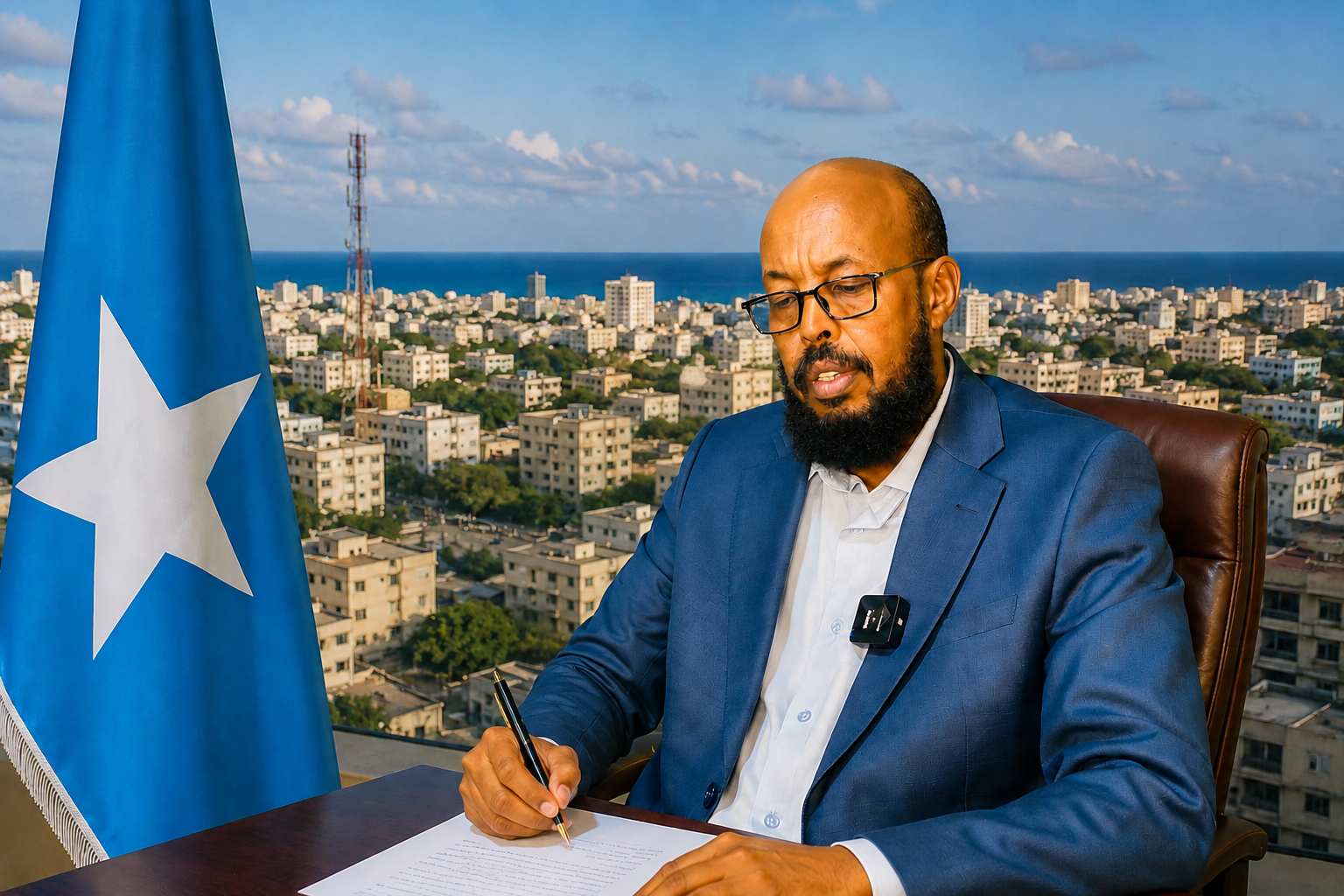
A Modern Strategic Research Report on Global Power Transitions, Western Vulnerability, and Somalia’s Emerging Geopolitical Leverage
By: Professor Shafic – Former Senior Diplomat & CEO, Brilliance Research & Consultant (BRCsom)
December 2025 – January 2026
Introduction
The international system is undergoing one of the most consequential transformations since the end of the Second World War. The geopolitical landscape that defined the late twentieth and early twenty-first centuries—marked by Western dominance, stable alliances, and predictable global economics—has fractured. As great powers reposition themselves, smaller but strategically located states are becoming pivotal nodes in shaping global outcomes. Somalia, long framed narrowly within the lenses of conflict and counterterrorism, is now emerging as an essential maritime, diplomatic, and geopolitical actor whose relevance extends far beyond its borders.
The shifting distribution of power among the European Union, the United Kingdom, the United States, and rising entities such as China and BRICS has intensified competition over influence, corridors of trade, technology, and political alliances. This competition is unfolding at a time when the risk landscape is expanding to include not only conventional security threats but also global vulnerabilities related to pandemics, emerging biological risks, cyberwarfare, and the weaponization of supply chains. The post-Cold War order no longer offers the stability it once promised; instead, a fluid multipolar environment has emerged in which alliances shift faster than institutions can reform.
This research, prepared at the end of 2025 and the threshold of 2026, aims to provide global think tanks, governments, diplomatic actors, and security institutions with a clear, evidence-based understanding of how global power is evolving—and how Somalia can strategically leverage its position in ways no other state can replicate. The argument is straightforward: in a world experiencing deep strategic volatility, Somalia holds a unique maritime, geographic, political, and intelligence advantage. Its networks, access points, cultural intersections, and maritime routes give it leverage that is increasingly recognized by both Western and emerging global powers. Somalia can transform from a security-recipient to a strategic partner—if the moment is seized now, not in the distant future.
Europe and the United Kingdom: A Strategic Contraction
Europe’s strategic environment has deteriorated significantly over the past decade. The shock of Brexit created lasting structural fractures between the European Union and the United Kingdom, weakening Europe’s unity at precisely the moment when global competition intensified. The war in Ukraine exposed Europe’s military dependency, energy vulnerability, and political inconsistency. Although European states have increased defense budgets, the gap between ambition and capability remains substantial.
Demographic decline across much of the continent, combined with rising political fragmentation, constrains Europe’s ability to project influence abroad. The continent’s strategic bandwidth is consumed by immediate crises—refugee flows, energy volatility, inflation, and right-wing political surges—leaving little room for coherent long-term policy toward Africa or the broader global South.
Europe desires a stable relationship with Russia, not only for security but for economic and energy stability. Yet the United States’ long-term strategic focus on containing China has created a divergence in Western priorities: Europe wants to manage Russia; the United States wants to weaken it only as much as necessary to avoid distraction from Asia. This strategic misalignment leaves Europe exposed. In the long run, Europe risks becoming a geopolitical object rather than a strategic actor—dependent on external protection, unable to shape outcomes independently, and gradually losing influence in regions like the Horn of Africa where emerging powers are more persistent and more adaptive.
The United States: Strategic Delay and Indo-Pacific Prioritization
The United States remains the most powerful military and technological actor on the planet, yet its strategic logic increasingly resembles the pattern observed in both World Wars: engagement is delayed until decisive intervention becomes advantageous. In the emerging global order, Washington appears willing to allow Europe and Russia to weaken one another while concentrating on the Indo-Pacific competition with China, which it views as the defining rivalry of the 21st century.
This approach is not abandonment but strategic triage. The United States calculates that the real long-term threat to its global leadership comes from China’s rise in technology, manufacturing dominance, innovation ecosystems, maritime expansion, and its growing network of political and economic agreements across Asia, Africa, and Latin America. As a result, Washington’s attention to Africa has become intermittent—strategically important but frequently overshadowed by Indo-Pacific priorities.
Yet Africa, and specifically the Horn of Africa, is increasingly central to global maritime routes, counterterrorism, supply-chain resilience, and great-power rivalry. Somalia’s geopolitical relevance intersects directly with U.S. interests, even if indirectly through maritime security, the Red Sea corridor, and the broader Indian Ocean framework.
Russia and China: Divergent Paths with Converging Effects
Russia and China present contrasting trajectories but complementary strategic pressures on the Western-led order. Russia’s war in Ukraine has drained its economic capacity and military reserves, limiting its global influence. Its long-term challenge to Europe is now more political and ideological than military.
China, however, continues building a stable long-term architecture of influence. Its economic engagement with Africa, its investments in digital infrastructure, and its leadership in artificial intelligence and advanced manufacturing create a structural challenge for Western powers. Through diplomatic forums and economic blocs such as BRICS, China is constructing parallel global institutions that reduce dependence on Western systems.
The convergence of Chinese economic power and Russian geopolitical disruption creates a two-front challenge for the West. The global order is no longer bipolar or unipolar—it is fragmented, fluid, and shaped by competing centers of influence.
Africa and the Return of Global Competition
Africa has become central to 21st-century geopolitical competition. The continent holds the world’s youngest population, vast mineral wealth, and several of the most critical maritime routes. Yet Western engagement has remained inconsistent, often focused on security rather than partnership. Meanwhile, emerging powers emphasize economic and technological collaboration.
BRICS offers African states leverage: alternative financing, diversified trade partners, and geopolitical bargaining power. But BRICS does not offer political rights, citizenship pathways, or the institutional protections available in Western states. Conversely, the West demands loyalty but often fails to treat African states as equal partners. This contradiction fuels a growing strategic shift where Africa seeks diversified alliances rather than exclusive relationships.
Somalia is central in this realignment.
Somalia’s Strategic Relevance in a Fragmenting Global Order
Somalia occupies one of the most important maritime positions in the world. Nearly 22 percent of global trade passes through waters adjacent to Somali territory. Control, monitoring, and partnership in this region are central to global food security, energy transport, and industrial supply chains. Somalia’s geographic significance alone makes it unavoidable for any serious global actor.
Beyond geography, Somalia possesses networks, relationships, and intelligence channels that external actors cannot replicate. Western partners, despite advanced technology, lack deep cultural and local access. Emerging powers often misunderstand clan dynamics, economic structures, and social ecosystems. Somali institutions, networks, and community structures offer visibility into areas where formal-state intelligence has limited reach.
Somalia’s conflict, often portrayed as purely internal, is also shaped by external actors, political rivalries, and the economics of counterterrorism. These dynamics have sustained instability while limiting Somalia’s ability to rebuild institutions. Yet Somalia’s unique access to information—social, cultural, religious, maritime, and economic—positions it as a crucial partner for any global actor seeking real stability in the Horn of Africa.
Parallel Governance and the Challenge of Al-Shabaab
Al-Shabaab operates not merely as an insurgency but as a shadow governance framework with its own taxation, dispute-resolution, intelligence, and administrative systems. This parallel structure complicates traditional security responses and underscores the need for political, economic, and societal strategies beyond purely military operations.
Western partners often underestimate the sophistication of these networks because external intelligence lacks community-embedded visibility. Somalia’s own networks, when empowered and supported through modern technological partnerships, can outperform any external CT framework.
Biological, Technological, and Global Vulnerabilities in a Sensitive Era
The world is entering a period where non-traditional threats—biological risks, pandemics, supply-chain fragility, cyberwarfare, and misinformation—can reshape geopolitical stability as profoundly as conventional conflict. The experience of COVID-19 demonstrated that global vulnerabilities can spread rapidly, transcending borders and overwhelming institutions.
Future risks may emerge from natural outbreaks, accidental laboratory incidents, or hostile misuse of emerging technologies. These risks justify a robust global prevention and early-warning architecture. Somalia, with its maritime routes, diaspora networks, and strategic geography, can contribute significantly to monitoring, early detection, and information flows—if integrated into global platforms for health security, maritime surveillance, and technological cooperation.
Somalia’s Immediate Leverage: Technology Transfer, Alliances, and Strategic Partnerships
Somalia stands at a pivotal moment where cooperation with both East and West can yield unprecedented opportunities. Technology transfer from partners in the United States, Europe, China, Turkey, Gulf states, and BRICS members can accelerate Somalia’s modernization. These transfers include digital governance, maritime monitoring, renewable energy systems, cybersecurity, and health-surveillance tools.
Somalia must not wait for future stability to negotiate these partnerships. Its strategic leverage exists today. Maritime corridors, counterterrorism expertise, intelligence networks, and diaspora distribution give Somalia significant diplomatic bargaining power. No major power—Western or emerging—can afford to ignore Somali cooperation in the Horn of Africa.
Somalia’s foreign policy should therefore balance relationships with both Western institutions and rising global actors. This dual-alignment approach enhances sovereignty, increases bargaining power, and positions Somalia as a neutral facilitator in global competition. The world is shifting quickly, and Somalia must act now, not tomorrow.
Forecasting Global Dynamics in 2026–2030
The next four years will likely feature intensified competition over maritime routes, digital infrastructure, resource corridors, and geopolitical alliances. The world will not return to previous stability. Instead, a fragmented system will emerge where influence is distributed among multiple poles.
Europe will continue facing internal strain. The United States will deepen its Indo-Pacific focus. China will expand its global partnerships. Russia will remain constrained but geopolitically disruptive. The Middle East will continue to shape global energy transitions. Africa will rise as a decisive arena of global influence.
Amid these shifts, Somalia will gain strategic relevance not only as a security focal point but as a maritime, diplomatic, and logistical hub connecting global corridors.
Conclusion
The world is entering a new geopolitical era defined by shifting alliances, technological disruption, and fragmented power structures. Somalia’s strategic value—maritime, diplomatic, cultural, and informational—will only increase as global competition intensifies. This research calls on policymakers, global think tanks, and diplomatic institutions to recognize Somalia not as a site of crisis, but as a strategic partner capable of shaping regional and global outcomes.
Somalia has the leverage. The world is shifting. The moment to act is now.